

York Chocolate
The image on this page is AI-generated and does not depict a real animal.
- Species
- Cat
- Origin
- United States
- Size
- Large
- Lifespan
- 13 - 15 years
- Temperament
- Playful Social Intelligent Curious Friendly
- Description
A true lap cat; sweet-natured, curious and follows its owner everywhere.
- Physical Traits
Long silky coat, solid or bicolor patterns in chocolate or lilac tones.
- Care / Environment Info
Lives indoors. Sheds moderately. Requires moderate grooming, brushing a few times a week recommended. Very high energy, needs plenty of play and stimulation. Very talkative and can meow loudly. Generally a very healthy breed.
York Chocolate Owner's Guide
Last updated:
Is a York Chocolate right for you?
This guide has to open with an honest warning: the York Chocolate is a breed that is, for practical purposes, almost impossible to find today. This rare US breed of chocolate-brown cat was never recognized by major federations like TICA, CFA, or FIFe; its last known breeder closed her program in 2016, and current sources describe the breed as either extinct or surviving in critically small, uncertain numbers. This page exists for people curious about this beautiful but nearly vanished breed's history and known traits — if you're hoping to buy a York Chocolate kitten from a breeder, adjust your expectations accordingly.
| Situation | Suitability | Note |
|---|---|---|
| Buyer wanting to adopt this breed today | Not applicable | Very low chance of finding an active, verifiable breeder |
| Apartment | Good (based on historical accounts) | Sources describe a calm cat suited to indoor life |
| Family with young children | Good (based on historical accounts) | Described as affectionate and fond of laps |
| Household able to keep up semi-long coat grooming | Suitable | The semi-long coat needs regular brushing |
| Household with fur allergies | Unclear | Some owners reported low allergen production, but there's no independent confirmation |
| Buyer who spots a "York Chocolate kitten" ad | Caution | With no registered breeders, pedigree verification is usually impossible |
| Someone researching a rare/historical breed | Excellent | This page exists exactly for that purpose |
In short: read the York Chocolate as an interesting, fragile chapter in cat-breed history, not as a breed you can realistically adopt today.
Before you adopt
If you come across a kitten advertised as a "York Chocolate," be cautious. With no verifiable, registered breeder network left, most such listings are likely marketing a brown-coated mixed-breed cat under the name. Ask for a pedigree, federation registration, or at least concrete information about the breeder's background; if none exists, what you have is most likely a tabby or mixed brown short- or long-haired cat — which doesn't make it any less lovable, just not a York Chocolate.
The breed's founding history involved close inbreeding (sibling and mother-son matings), which is a general genetic principle known to raise the risk of inherited problems appearing. Since no independent health study exists, how much this risk actually materialized in practice is unknown.
Temperament
What we know comes not from an independent behavioral study but from the breed's founder and a handful of breeders' own observations; weigh it accordingly.
Sources describe the York Chocolate as affectionate, fond of laps, and attached to people; it would follow its owner around and want to be held and cuddled. It's described as intelligent, energetic, and curious, with some individuals reportedly playing fetch or carrying objects in their mouths.
It's said to have enjoyed water, sometimes joining owners in the shower or bath. It could reportedly be shy with strangers.
Fitting its farm-cat origins, it's described as a capable hunter, good at catching mice.
Health issues and lifespan
This section is flagged needs_review because no independent veterinary health study of the York Chocolate exists; what we have is limited to the breed founder's and a few breeders' own observations.
Sources generally place lifespan around 13-15 years, though that figure also rests on general feline lifespan ranges and a handful of records rather than a broad independent study.
- Crossed eyes: Reported by the breed's founder in fewer than ten percent of cats. Described as a cosmetic trait rather than a serious health problem.
- Flea allergy: Also noted by the founder in a small number of individuals; manageable with standard flea prevention.
- General risk from a small, closed gene pool: The breed descends from a small number of closely related cats. Populations with low genetic diversity are generally known to carry an elevated risk of inherited disease, but there's no independent record of which specific conditions this produced in the York Chocolate.
- General, breed-independent advice: If you have adopted a genuinely verified York Chocolate or its descendant, routine annual vet checks and standard heart/kidney screening are a reasonable precaution — based on general caution, not on documented breed-specific findings.
Feeding
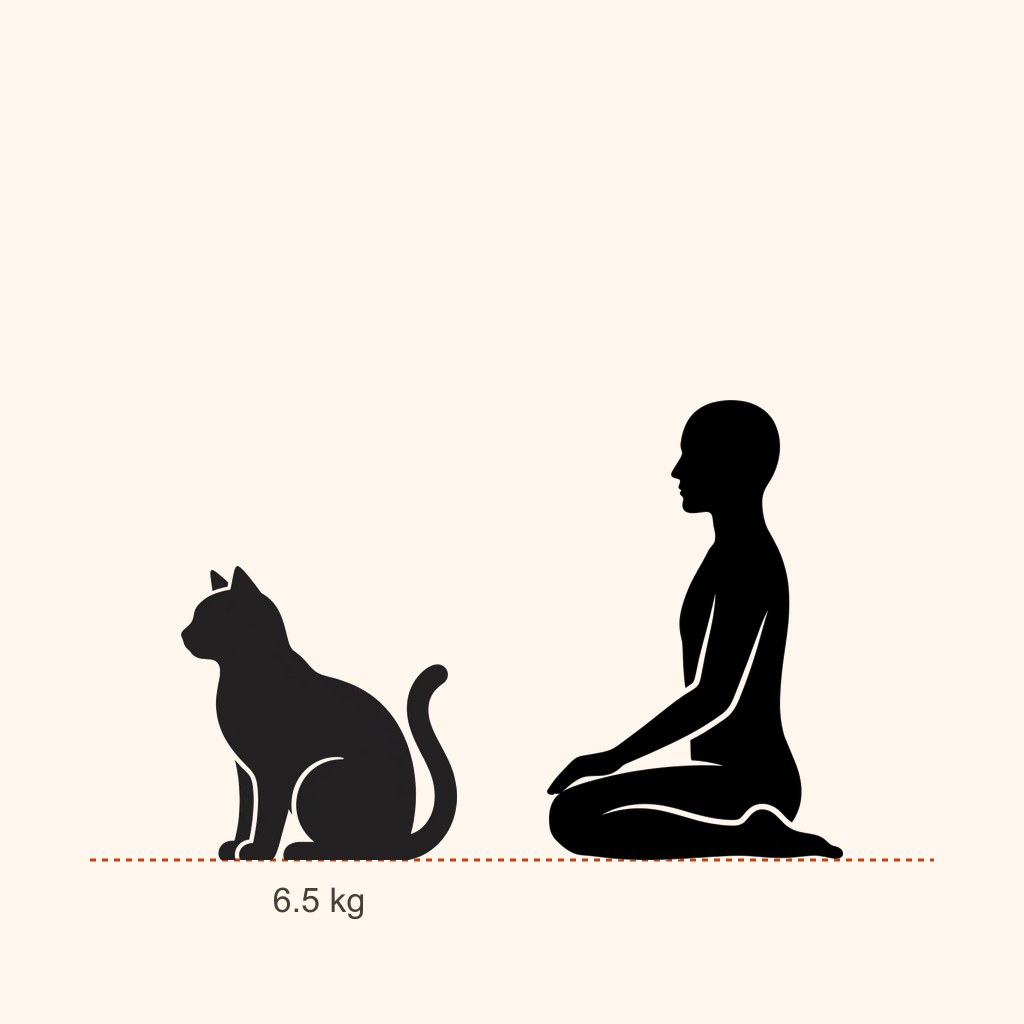
An adult York Chocolate (4-7 kg, with weight estimates varying between sources) needs the energy equivalent of about 60-85 g of dry food per day.
- Kitten (2-12 months): Kitten food, three to four meals a day.
- Adult: High protein, low carbohydrate; being a large-bodied cat, adjust portions to body condition.
- Senior (10+ years): Annual bloodwork and kidney/heart monitoring are a sensible general precaution, even without a documented breed-specific risk.
Grooming and coat
Sources describe a silky, semi-long coat that sheds little and needs relatively modest care — though it still needs regular attention.
- Brush two to three times a week; check the armpits and belly area especially to prevent matting.
- With little to no undercoat reported, bathing needs are generally low.
- Trim nails every two to three weeks.
- Brush teeth several times a week.
- Check ears monthly.
Living space and enrichment
- Social contact. Sources describe a people-oriented breed; daily attention and lap time matter.
- Water play. Given its reported fondness for water, a shallow dish or supervised bath time may be welcome.
- Play that satisfies hunting instinct. Wand toys and small "hunt" simulations could be a good match.
- A regular brushing routine. Set a weekly grooming schedule to prevent the semi-long coat from matting.
- A calm environment. Since it could reportedly be shy with strangers, provide a quiet corner it can retreat to in busy, guest-heavy households.
History
The York Chocolate's story begins in 1983 on Janet Chiefari's goat dairy farm in New York State. A mating between Chiefari's black-and-white long-haired female cat and a neighbor's solid black cat produced a brown-coated female kitten Chiefari named "Brownie."
In 1985, Brownie was mated with her half-brother, producing chocolate-colored kittens that became the breed's foundation. In 1990, a lighter dilute tone called "lavender" appeared due to the dilution gene. Chiefari worked with these closely related cats over four generations to fix the color.
The breed gained "experimental" status from the Cat Fanciers' Federation (CFF) in March 1990 and reached championship status there in 1991-92. It was recognized by the World Cat Federation (WCF) and the International Progressive Cat Breeders Alliance (IPCBA) in 2002. In Italy, known as "Il Gatto Cioccolato," it gained a following, and the International York Chocolate Federation (IYCF) was founded there in 2003, though the club went effectively inactive from 2004 onward. Major international federations like TICA, CFA, and FIFe never recognized the breed.
By 2005, there were an estimated 60 York Chocolates worldwide. The last kitten born in France arrived in 2010. In 2016, the last known breeder (Debbie Reber) closed her program. Current sources say it's unknown whether a verified, unaltered York Chocolate is alive today; the breed is considered either functionally extinct or surviving in critically small numbers. It's a striking example of how fragile a rare breed can be when it starts from a small gene pool and never reaches a broad breeder network.
This guide is for information only and is not a substitute for veterinary advice. Prices are approximate and vary by region and time.
Adoption Prep Checklist
Housing
-
Cat bed
Cats want a safe space of their own to rest.
-
Cat climbing tree
Satisfies the natural scratching instinct and protects furniture.
Feeding
-
Dry/wet cat food
Quality cat food is needed for balanced nutrition.
-
Food and water bowl set
Needed for daily feeding and water access.
Grooming
-
Cat litter and litter box
Essential for the cat's toilet needs.
-
Cat de-shedding brush
Regular brushing reduces hairball formation.
Activity
-
Interactive cat toy
Cats release energy through play.
-
Cat carrier
Needed for safe transport to vet visits.
Frequently Asked Questions
Does the York Chocolate shed?
It sheds a moderate amount. Brushing two or three times a week noticeably reduces both loose hair and matting.
Can the York Chocolate live in an apartment?
Yes. It lives comfortably in an apartment as long as its daily needs are met. What matters is not floor area but consistent exercise and mental stimulation.
Is the York Chocolate good with children?
Generally yes. It adapts well to families with children. Even so, interactions should be supervised and children taught to respect the animal’s boundaries.
Is the York Chocolate suitable for first-time cat owners?
Partly. Someone with basic experience will manage well, but it would not be the first choice for a complete beginner.
How much exercise does the York Chocolate need?
It is high-energy and needs vigorous daily activity. Mental stimulation matters as much as physical exercise; without enough to do, destructive behaviour follows.
Can the York Chocolate be left alone during the day?
It can be left alone for a few hours. Long, routine absences can bring on boredom-driven behaviour problems; enrichment and a predictable routine reduce that risk.
How long does the York Chocolate live?
The York Chocolate lives 13 - 15 years on average. Diet, regular veterinary check-ups and early screening for hereditary conditions all affect this directly.
Where does the York Chocolate come from?
The York Chocolate originates from United States. The geography a breed was developed in, and the job it was bred for, explain much of its temperament and care needs today.