

Munchkin
The image on this page is AI-generated and does not depict a real animal.
- Species
- Cat
- Origin
- United States
- Size
- Small
- Lifespan
- 10 - 15 years
- Temperament
- Agile Adaptable easygoing Intelligent Playful
- Description
Outgoing, enjoys being held, energetic and far more agile than it looks.
- Physical Traits
Short legs (genetic dwarfism), coat length and color can vary widely.
- Care / Environment Info
Lives indoors. Sheds moderately. Easy to care for, brushing once a week is enough. Quite energetic and playful. Moderately vocal/talkative. Some breed-specific health monitoring is recommended.
Munchkin Owner's Guide
Last updated:
Is a Munchkin right for you?
The Munchkin is a cat breed known for its short legs. The shortness comes from a natural mutation affecting cartilage development, and that same mutation is also the subject of the breed's biggest controversy: some cat registries treat it as a breed trait, others as a welfare-compromising defect. Knowing this debate before adopting matters.
| Situation | Suitability | Note |
|---|---|---|
| Apartment | Good | Active but does not need high jumps; adapts well |
| Family with young children | Good | Sociable and playful; avoid rough handling |
| First-time cat owner | Good | Easy temperament; the main thing to watch is health monitoring |
| Alone 8+ hours a day | Moderate | Social by nature; needs enrichment for long solo hours |
| Household with fur allergies | Moderate | Comes in short- and long-haired variants, both shed |
| Home without a tall cat tree or shelves | Caution | Wants to climb but has limited jump range; needs low-step layouts |
| Adopters sensitive to ethical debates | Caution | The short-leg mutation divides opinion within the veterinary community |
The Munchkin suits families who find the short-legged look endearing and who accept close monitoring of spine and joint health in return.
Before you adopt
Recognition of the Munchkin varies among cat registries: TICA recognised the breed in 1994 and grants it championship status; CFA does not recognise it at all, and the UK's GCCF and the Europe-based FIFe likewise refuse recognition. FIFe explicitly states it does not accept breeds based on dwarfism and has named the Munchkin as an example of that position. TICA's rationale is that the mutation arose naturally and that risks can be managed through responsible breeding.
When choosing a kitten, look for parents free of spine and joint problems, and avoid extreme types with excessively short or disproportionate legs. "Non-standard" Munchkins (cats carrying the mutation but not showing short legs) are also used in breeding programmes; leg length alone is not a health indicator, but extreme shortness is a risk factor.
Temperament
Despite its short legs, the Munchkin is surprisingly agile and playful; it can run and jump, just with a lower jump height than an average cat. It is curious and sociable, adapting easily to people and other pets.
Some Munchkins display a behaviour of sitting up on their hind legs to survey their surroundings, rabbit-style; this has become part of the breed's popular image, though not every individual does it.
It is intelligent and playful, engaging well with interactive toys and hide-and-seek style hunting games. It generally gets on well with other cats and dogs, making it a practical choice for multi-pet households.
Health issues and lifespan
Average lifespan is generally given as around 12-15 years in sources.
- Osteoarthritis: The cartilage development difference caused by the short-leg mutation can increase the load on joints; joint pain and reduced willingness to move can appear with age. Weight control is protective.
- Lordosis: An abnormal inward curvature of the spine; some individuals show no symptoms while others experience back pain, a lopsided stance, and reduced mobility.
- Pectus excavatum: A congenital chest deformity where the chest develops in a sunken shape; mild cases can be asymptomatic, while severe cases can compress the heart and lungs and cause breathing difficulty, sometimes requiring surgery.
- General predisposition to back/spine issues: In short-legged breeds (similar in principle to chondrodysplasia-type mutations also seen in some dog breeds), the mechanical load on the spine can differ; regular veterinary checks matter for catching early signs.
Sources do not clearly agree on how often these risks appear in any given individual, so this section is flagged rather than given a precise rate. Requesting an up-to-date orthopedic exam before adopting is good practice.
Feeding
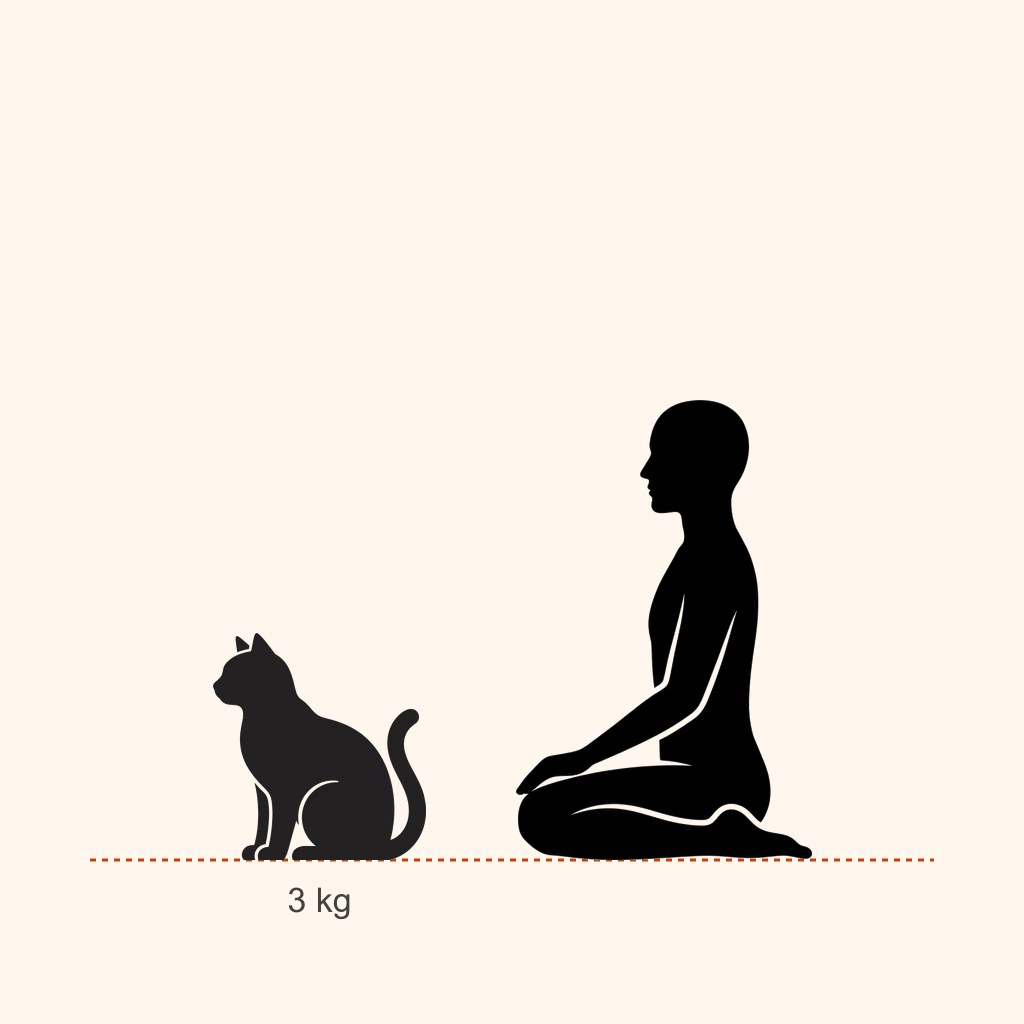
An adult Munchkin (2.5-4 kg / 5.5-9 lb) eats close to the standard amount for a medium-sized cat; weight monitoring matters especially in this breed because excess weight places direct extra load on the short legs and spine.
- Kitten (2-12 months): Kitten food, three to four meals a day.
- Adult: Balanced protein; foods with omega-3 for joint support can be a good choice.
- Senior (8+ years): Calories reduced; joint supplements can be considered on veterinary advice.
Measured portions and regular weigh-ins are basic care in this breed, not an optional extra.
Grooming and coat
The Munchkin comes in both short- and long-haired variants.
- Short-haired cats need brushing once a week, long-haired ones two to three times a week.
- Short legs can make self-grooming harder; check the belly and rear area in particular.
- Nails every two to three weeks.
- Brush teeth several times a week.
- Check ears monthly.
Living space and enrichment
- A low-step layout. Even with the urge to climb a tall cat tree, adding intermediate steps or a ramp protects the joints.
- Measured jumping opportunities. Favour games that use horizontal distance over very high jumps.
- A weight-friendly play routine. A few short play sessions a day prevent weight gain from inactivity.
- A wide, low-sided litter tray. Makes getting in and out easier for a short-legged cat.
- Social enrichment. Because it is a social breed, companionship with another cat or dog reduces the stress of being alone.
- Safe climbing spots. A low window perch can be as satisfying as a full cat tree.
History
Short-legged cats have appeared occasionally around the world for decades, but today's Munchkin breed traces to a pregnant stray cat found in Louisiana in 1983. The line developed from her kittens was presented to TICA in the early 1990s and officially recognised in 1994.
Since its introduction, the breed has been one of the most discussed examples of health and ethics debate in the cat fancy. TICA continues to recognise the breed, arguing the mutation arose naturally and spontaneously and that similar short-leg mutations have been reported in wild cat populations too; CFA, GCCF, and FIFe do not accept breeds based on short-leg mutations as a matter of principle. This makes the Munchkin both a beloved breed and one of the most debated within the veterinary community.
This guide is for information only and is not a substitute for veterinary advice. Prices are approximate and vary by region and time.
Adoption Prep Checklist
Housing
-
Cat bed
Cats want a safe space of their own to rest.
-
Cat climbing tree
Satisfies the natural scratching instinct and protects furniture.
Feeding
-
Dry/wet cat food
Quality cat food is needed for balanced nutrition.
-
Food and water bowl set
Needed for daily feeding and water access.
Grooming
-
Cat litter and litter box
Essential for the cat's toilet needs.
-
Cat de-shedding brush
Regular brushing reduces hairball formation.
Activity
-
Interactive cat toy
Cats release energy through play.
-
Cat carrier
Needed for safe transport to vet visits.
Frequently Asked Questions
Does the Munchkin shed?
It sheds a moderate amount. Brushing two or three times a week noticeably reduces both loose hair and matting.
Can the Munchkin live in an apartment?
Yes. It lives comfortably in an apartment as long as its daily needs are met. What matters is not floor area but consistent exercise and mental stimulation.
Is the Munchkin good with children?
Generally yes. It adapts well to families with children. Even so, interactions should be supervised and children taught to respect the animal’s boundaries.
Is the Munchkin suitable for first-time cat owners?
Yes. Its care and training are relatively forgiving, which makes it a sound choice for first-time owners.
How much exercise does the Munchkin need?
It is high-energy and needs vigorous daily activity. Mental stimulation matters as much as physical exercise; without enough to do, destructive behaviour follows.
Can the Munchkin be left alone during the day?
It can be left alone for a few hours. Long, routine absences can bring on boredom-driven behaviour problems; enrichment and a predictable routine reduce that risk.
How long does the Munchkin live?
The Munchkin lives 10 - 15 years on average. Diet, regular veterinary check-ups and early screening for hereditary conditions all affect this directly.
Where does the Munchkin come from?
The Munchkin originates from United States. The geography a breed was developed in, and the job it was bred for, explain much of its temperament and care needs today.