

Bambino
The image on this page is AI-generated and does not depict a real animal.
- Species
- Cat
- Origin
- United States
- Size
- Small
- Lifespan
- 12 - 14 years
- Temperament
- Affectionate Lively active Friendly Intelligent
- Description
Enjoys being cuddled and spending time with its family; an affectionate cat.
- Physical Traits
Usually hairless or covered with very fine peach-fuzz skin, short legs, large upright ears.
- Care / Environment Info
Lives indoors. Being hairless it doesn't shed, but regular (weekly) baths are needed to maintain skin oil balance, and it's sensitive to cold/sun. Very high energy, needs plenty of play and stimulation. Moderately vocal/talkative. Generally a very healthy breed.
Bambino Owner's Guide
Last updated:
Is a Bambino cat right for you?
The Bambino is a fairly new hybrid that combines the Sphynx's hairlessness with the Munchkin's short legs. The result is an extremely people-oriented, playful, and eye-catching little cat. But both of the traits that make this breed distinctive are genetic mutations, each already debated on its own; put together, the grooming workload and the health monitoring needs both double.
| Situation | Suitability | Note |
|---|---|---|
| Apartment | Excellent | Strictly an indoor cat; limited jumping ability |
| Family with young children | Moderate | Social and playful, but bare skin scratches easily during rough handling |
| First-time cat owner | Poor | Skin care, temperature management, and spine/joint monitoring all at once is a lot to learn |
| Alone 8+ hours a day | Poor | Prone to separation anxiety; needs constant attention |
| Household with fur allergies | Wrong expectation | The allergen is in saliva and skin, not fur; hairlessness is no guarantee |
| Cold home | Poor | Loses heat fast; heating and clothing are a real requirement |
| An adopter sensitive to ethical debates | Caution | Combining two separate mutations is controversial among vets |
The most honest question here: are you ready to take on both the skin and temperature care of a hairless cat, and the lifelong joint and spine monitoring of a short-legged cat, at the same time? If either half is missing, this breed struggles.
Before you adopt
The Bambino takes its name from the Italian word for "baby" and was developed in 2005 in Arkansas, USA, by breeders Stephanie and Pat Osborne at their Holy Moly Cattery. TICA (The International Cat Association) recognized the breed only as "experimental" in 2006; major registries such as the CFA, GCCF, and FIFe still do not recognize the Bambino today.
This lack of recognition is not a coincidence. The short-leg mutation from the Munchkin and the hairlessness mutation from the Sphynx are each controversial in their own breeds; the Bambino combines both in one cat. In 2019, the Netherlands' food and consumer product safety authority ordered a breeding pair to stop producing Bambinos, citing painful, limited mobility caused by dwarfism. That shows the welfare debate around this breed is not purely theoretical.
Before adopting a Bambino, decide with this in mind: choosing the most extreme type — the shortest legs, the most curved spine — increases the risk. If you can see the kitten's parents, avoid disproportionately short or crooked-looking legs. Laws vary by country and region on owning or breeding cats with these mutations, so check local rules; in Turkey, for example, there is no specific breed ban, but this is still an ethically debated breed internationally, and the breed itself is extremely rare here. Be cautious of listings that offer no health history or documentation.
Temperament
The Bambino is highly social, curious, and playful; it follows its owner from room to room and lets you know when it isn't getting enough attention. It is intelligent and can learn simple games, even fetch.
Because of its short legs, it cannot jump as high as a typical cat, which makes it more of a "ground-level" cat without dampening its energy or curiosity. It seeks out warmth: a radiator, a sunny windowsill, or a lap are this breed's favorite spots.
It does not tolerate being alone well. A Bambino left alone for long stretches may show its distress through destructive behavior or persistent vocalizing. It generally gets on well with children and other pets, though its bare skin needs supervision against rough handling and scratches.
Health issues and lifespan
Sources generally give an average lifespan around 12 to 14 years. This breed's health profile combines risks from both the Sphynx and Munchkin lines.
- Hypertrophic cardiomyopathy (HCM): Inherited from the Sphynx side, the most common heart disease in cats. It progresses silently; see a vet the same day if you notice lethargy, rapid breathing, or sudden hind-leg weakness. Regular echocardiograms from adulthood onward are recommended.
- Skin problems: Without fur, skin oil accumulates on the surface, which can lead to fungal infection and acne. If you notice redness or odor, review your bathing routine and consult a vet.
- Temperature dysregulation: No insulating coat means it chills easily and can genuinely get sunburned after too long in direct sun. Shivering and constantly seeking warmth signal it is cold.
- Lordosis: Inherited from the Munchkin side, an abnormal inward curvature of the spine. Some individuals show no symptoms; others develop back pain and reduced mobility.
- Pectus excavatum: A concave, sunken chest wall. Mild cases may be symptomless; severe cases cause breathing difficulty and need veterinary monitoring.
- Osteoarthritis: Short legs carrying a normal-length body place extra load on the joints; joint pain can appear with age, and weight control is protective.
- Ear wax buildup: Little fur in the ears means wax accumulates quickly; weekly cleaning is needed.
Feeding
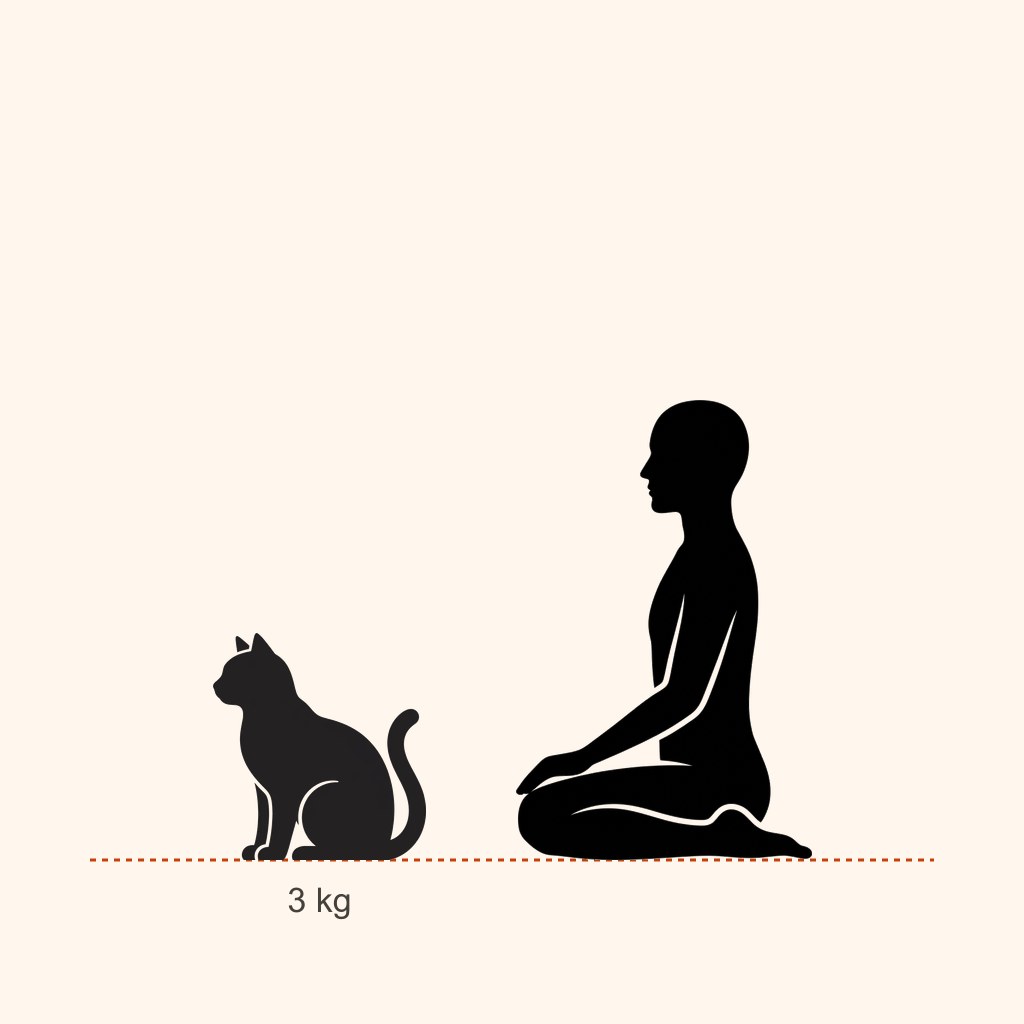
An adult Bambino is small (roughly 2.5-3.5 kg), but heat loss inherited from the Sphynx side may mean it needs more energy than other small breeds to maintain body temperature.
- Kitten (2-12 months): Kitten food, three to four meals a day.
- Adult: A balanced, high-protein diet. This is where you need real balance: the Sphynx side doesn't tolerate excessive restriction, while the Munchkin side can't carry extra weight. Set portions by scale, not by eye.
- Senior (8+ years): A diet set with your vet based on heart and joint monitoring.
Weighing your cat monthly lets you catch a small gain before it loads the joints and spine.
Grooming and coat
- Bathe weekly with a gentle, cat-safe shampoo; unremoved skin oil leads to inflammation.
- Wipe with a damp, unscented cloth between baths.
- Clean the ears weekly; wax builds up quickly in this breed.
- Skin folds (neck, armpits) should be wiped and dried.
- Nails every two weeks, teeth several times a week.
- Consider clothing in cold weather and skin protection in hot, sunny conditions.
Living space and enrichment
- Warmth. A heated bed or clothing is needed when the room temperature drops.
- Low-level access. Since jumping is limited, ramps and intermediate steps make higher spots reachable.
- Soft surfaces. Unprotected skin can be irritated by rough or hard flooring.
- Measured, regular play. Two short sessions a day meet mental needs and help with weight control.
- A companion. If it will be alone for long stretches, seriously consider a second cat.
- Strictly indoors. Sun, cold, and injury risk mean it should never go outside.
History
The Bambino emerged in 2005 in the US when Stephanie and Pat Osborne deliberately crossed the Sphynx and the Munchkin. The goal was to combine the most eye-catching features of two popular breeds into one cat. TICA began registering the breed as experimental in 2006, a status meaning the breed is still in development and cannot compete for championship titles.
The Bambino still is not recognized by most major registries today; the main reason cited is that deliberately combining two separate skeletal mutations raises welfare concerns. The 2019 Dutch ruling was a concrete example of that debate. The breed has a small but devoted following; anyone considering adopting one should decide with this history and debate in mind.
This guide is for information only and is not a substitute for veterinary advice. Prices are approximate and vary by region and time.
Adoption Prep Checklist
Housing
-
Cat bed
Cats want a safe space of their own to rest.
-
Cat climbing tree
Satisfies the natural scratching instinct and protects furniture.
Feeding
-
Dry/wet cat food
Quality cat food is needed for balanced nutrition.
-
Food and water bowl set
Needed for daily feeding and water access.
Grooming
-
Cat litter and litter box
Essential for the cat's toilet needs.
-
Short-hair cat brush
Regular brushing reduces hairball formation.
Activity
-
Interactive cat toy
Cats release energy through play.
-
Cat carrier
Needed for safe transport to vet visits.
Frequently Asked Questions
Does the Bambino shed?
It sheds almost nothing. Regular care is still needed for skin and coat health; in hairless breeds that means skin cleaning rather than brushing.
Can the Bambino live in an apartment?
Yes. It lives comfortably in an apartment as long as its daily needs are met. What matters is not floor area but consistent exercise and mental stimulation.
Is the Bambino good with children?
Generally yes. It adapts well to families with children. Even so, interactions should be supervised and children taught to respect the animal’s boundaries.
Is the Bambino suitable for first-time cat owners?
Partly. Someone with basic experience will manage well, but it would not be the first choice for a complete beginner.
How much exercise does the Bambino need?
It is high-energy and needs vigorous daily activity. Mental stimulation matters as much as physical exercise; without enough to do, destructive behaviour follows.
Can the Bambino be left alone during the day?
It can be left alone for a few hours. Long, routine absences can bring on boredom-driven behaviour problems; enrichment and a predictable routine reduce that risk.
How long does the Bambino live?
The Bambino lives 12 - 14 years on average. Diet, regular veterinary check-ups and early screening for hereditary conditions all affect this directly.
Where does the Bambino come from?
The Bambino originates from United States. The geography a breed was developed in, and the job it was bred for, explain much of its temperament and care needs today.